KNOW YOUR RIGHTS
The MRP Dilemma: When Is It Legal to Charge More Than the Printed Price?
Ever wondered why restaurants can legally charge ₹150 for a ₹20 water bottle while local shops face massive fines for adding just ₹1 over the MRP? Discover your absolute consumer rights, the penalties for retail overcharging, and the "hospitality exception".
6/1/20263 min read
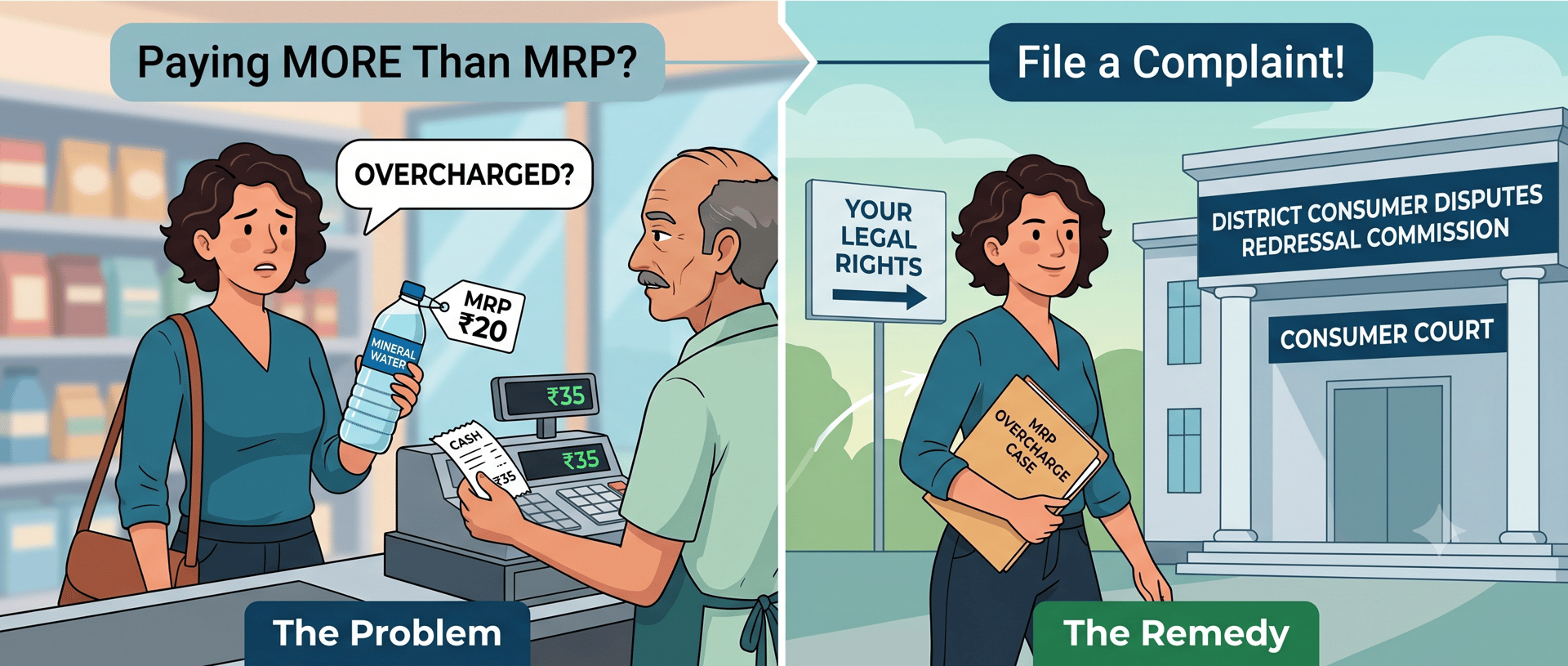
We have all been there. You finish a pleasant meal at a nice restaurant, ask for the bill, and realize you’ve just been charged ₹150 for a packaged water bottle that clearly states a Maximum Retail Price (MRP) of ₹20. To the average consumer, this feels like daylight robbery.
It raises an immediate, logical question: If it’s called the Maximum Retail Price, how can anyone legally charge more?
The answer lies at the intersection of retail law and a landmark Supreme Court judgment that fundamentally changed how the hospitality industry prices its goods. Here is a complete breakdown of your rights regarding MRP, the strict penalties for retail violations, and the infamous "restaurant exception."
The Ironclad Rule: MRP in Retail Shops
Let’s start with the standard retail environment. If you are purchasing a pre-packaged good from a local grocery store, a supermarket, a bakery, or a multiplex counter (without seating services), the law is absolute.
Under the Legal Metrology (Packaged Commodities) Rules, 2011, the MRP is the highest price that can legally be charged to a consumer. It is inclusive of all taxes.
There are no grey areas here. Retailers cannot legally charge extra for "handling" or "cooling." Consumer courts have repeatedly struck down the practice of local shops charging ₹2 or ₹5 extra for refrigerating a soft drink, ruling that the printed MRP already includes the retailer's margin, which is meant to cover overhead costs like electricity.
Penalties and Consumer Remedies
When a standard retailer violates this rule, the law provides heavy legal ammunition for the consumer.
Charging above the MRP is a direct offense under Section 36 of the Legal Metrology Act, 2009. The penalties are stringent:
First Offense: A fine of up to ₹25,000.
Second Offense: A fine extending up to ₹50,000.
Subsequent Offenses: A fine up to ₹1 Lakh, and potential imprisonment.
What can you do? If a shopkeeper refuses to sell at the MRP, always ask for a printed bill showing the inflated price. This is your prime evidence. You can file a grievance through the National Consumer Helpline or approach the District Consumer Disputes Redressal Commission. Courts routinely award financial compensation to consumers in these cases, classifying overcharging as an "unfair trade practice" and a "deficiency in service."
The Supreme Court Exception: Why Restaurants Can Charge More
If the law is so strict on retail shops, how do 5-star hotels and fine-dining restaurants get away with a 500% markup on a standard water bottle?
The legal landscape shifted dramatically in 2017 with a landmark Supreme Court judgment in the case of Federation of Hotel and Restaurant Associations of India (FHRAI) v. Union of India.
The core dispute was whether the strict retail pricing rules of the Legal Metrology Act applied to the hospitality sector. The Supreme Court ruled in favor of the hotels, relying on the legal concept of a "Composite Service."
Here is the court's reasoning: When you buy a water bottle at a grocery store, it is a simple "sale of goods." However, when you order that same bottle while seated inside a restaurant or a hotel, the transaction fundamentally changes. You are not just buying water; you are entering into an indivisible contract for hospitality.
The court noted that the inflated price on your restaurant bill covers a range of hidden overheads:
The air conditioning and premium ambiance.
The cutlery, glassware, and linen.
The service provided by the waiting staff.
The general upkeep of the property.
Because the transaction is dominated by this "service" element rather than a pure retail sale, the Supreme Court concluded that the strict MRP ceiling under the Legal Metrology Act does not apply. Therefore, hotels and restaurants cannot be prosecuted for selling pre-packaged products above the printed MRP as long as you are seated and utilizing their hospitality services.
The Over-the-Counter Caveat
It is crucial to note a small but significant caveat to the Supreme Court ruling. The exception applies strictly to patrons utilizing the establishment's services.
If you walk into a hotel or restaurant, go to the counter, and purchase a water bottle as a simple "takeaway" without sitting down or using their hospitality services, you have strong legal grounds to argue that this was a pure retail sale. In such a scenario, demanding the MRP price is entirely justified.
The Final Word
While paying exorbitant prices for basic commodities in restaurants remains a frustrating experience for consumers, the legal boundary is now clearly drawn. In a retail shop, the MRP is your absolute shield. In a restaurant, you are paying for the experience—and the law grants the establishment the freedom to set the price for that experience.
Knowing this distinction empowers you to fight back where the law supports you, and saves you a fruitless argument where it doesn't.
For more legal insights, rights awareness, and updates, keep following Legalfriendamithab.
CONTACT
Reach out anytime for legal support.
Phone
+91 6238662323
© 2026 Adv.Amithab Sankar. All rights reserved.